BEYOND THE PUMP: WHY PRESIDENT TINUBU’S FUEL SUBSIDY REFORM DESERVES RECOGNITION
By Halimat Ahouiza Aliu
President Bola Ahmed Tinubu’s decision to confront Nigeria’s petrol subsidy problem deserves recognition for addressing a costly weakness in the country’s public finances. The hardship associated with the adjustment deserves equally serious attention. Higher transport and business costs have placed considerable pressure on households. A fair assessment must hold both realities in view while asking whether continuing the old system would have secured a better future.
The case for the reform begins with a simple question: what could Nigeria sustainably afford? A subsidy does not make fuel costless. It transfers part of the price from the buyer at the filling station to the public purse. When that obligation grows faster than available resources, the consequences appear elsewhere: heavier borrowing, weaker public services or less investment in the infrastructure that makes everyday life easier.
The World Bank estimated Nigeria’s petrol subsidy cost at about ₦4.5 trillion in 2022. That was a substantial commitment in a country with pressing needs for schools, healthcare, electricity and transport infrastructure. Continuing such expenditure carried a real opportunity cost: resources devoted to maintaining an artificially low pump price could not simultaneously serve every other public priority. [1]
The arrangement was also poorly targeted. The World Bank found that the bottom 40 per cent of Nigerians purchased less than 3 per cent of the petrol sold, receiving a disproportionately small direct share of the subsidy. They nevertheless benefited indirectly through transport and other petrol-dependent services. Those indirect benefits explain why removal hurt ordinary people; the uneven direct distribution explains why a blanket petrol subsidy was an expensive instrument for protecting them. [1]
This is the economic distinction that matters. Government should support people facing hardship, but support can be designed to reach those who need it through reliable public transport, functioning public services and properly administered social protection. The effectiveness of that approach depends on delivery. Replacing an inefficient subsidy creates an opportunity for better protection; it does not automatically achieve it.
Earlier administrations understood the problem and attempted reform. President Goodluck Jonathan’s January 2012 removal was partly reversed following protests. Under President Muhammadu Buhari, price adjustments in 2016 and the removal of the price cap in 2020 were followed by renewed subsidies as regulated prices again fell below supply costs. The historical record therefore calls for fairness: previous governments took steps, but reform repeatedly failed to remain effective. [2]
Whatever the intentions behind those reversals, their effect was to postpone an increasingly expensive adjustment. Keeping petrol cheap by transferring its rising cost to government could offer temporary relief while leaving the underlying financing problem unresolved. That is the defensible meaning of postponing the proverbial evil day: the obligation remained, and its eventual resolution became more difficult.
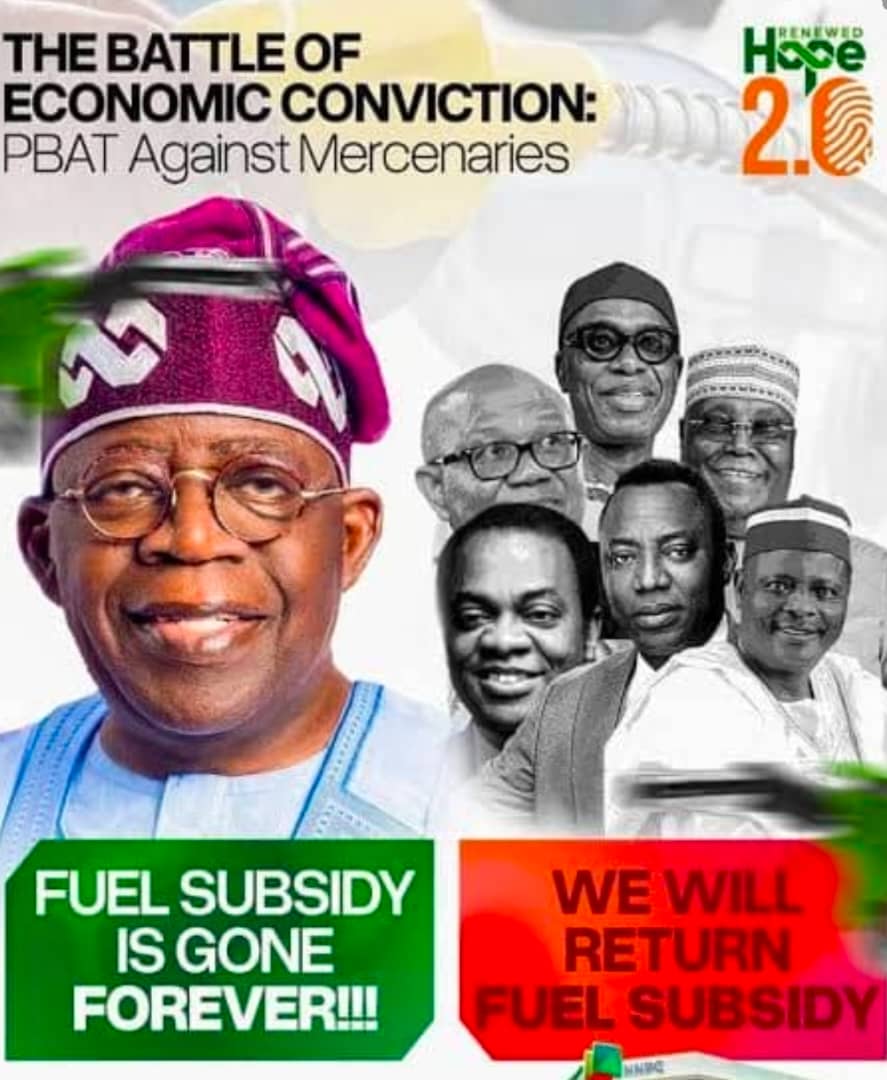
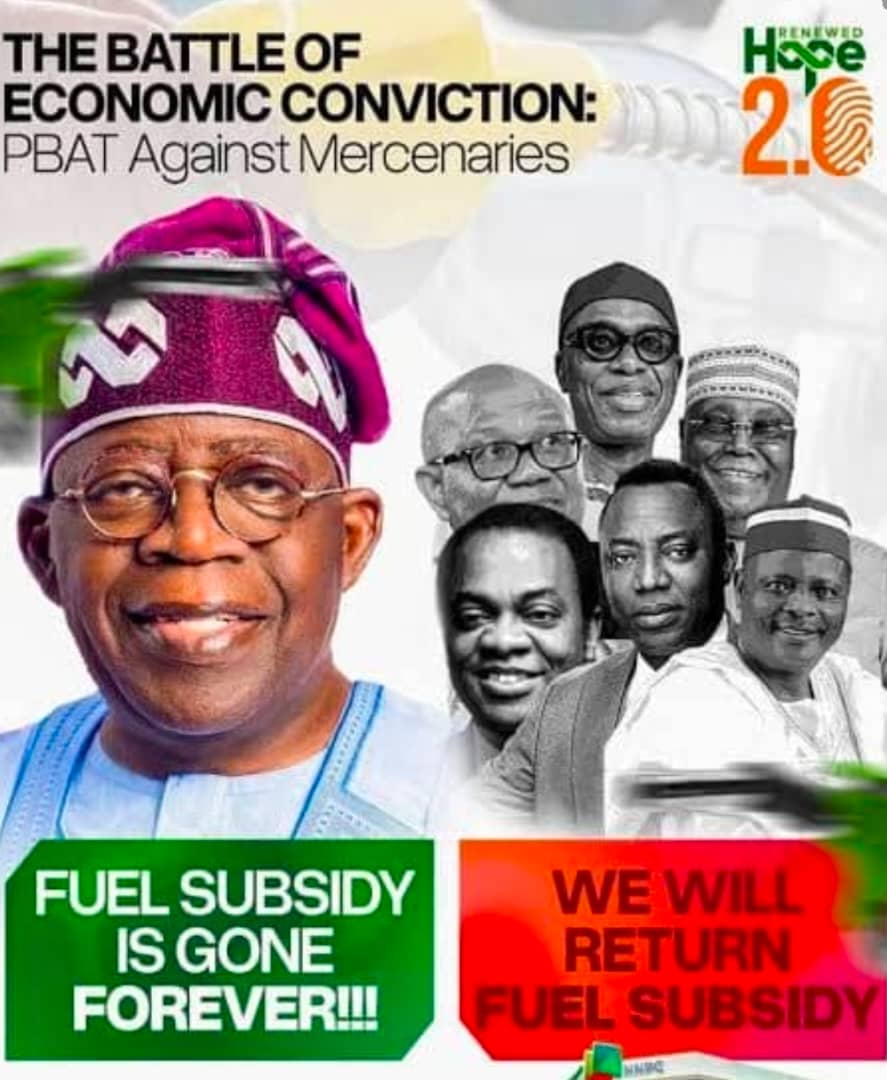
Tinubu inherited that difficulty. In his national broadcast of 31 July 2023, he explained that the inherited appropriation did not provide for petrol subsidy beyond June 2023. His administration chose to carry the reform forward. That decision deserves credit because it confronted an established fiscal problem despite the political cost of doing so. [3]
Precision about the timeline is necessary. The announcement of 29 May 2023 began the reform; it did not immediately eliminate every implicit subsidy. Subsequent price controls and exchange-rate movements meant that support persisted or re-emerged. The IMF’s 2025 assessment records the abolition of implicit subsidies in October 2024. Tinubu’s record should therefore be judged on the sustained process of reform, rather than on an inaccurate claim that the entire problem disappeared on inauguration day. [3, 11]
One important gain is a reduction in the financial distortion that rewarded diversion of subsidised petrol. The World Bank’s public finance review documented how the gap between Nigeria’s subsidised price and prices in neighbouring countries created powerful incentives for smuggling. Moving prices closer to supply costs reduces the subsidy-created opportunity for arbitrage. It cannot, by itself, end smuggling or substitute for effective border enforcement, but it addresses an economic incentive that enforcement alone struggled to overcome. [5]
A second gain is greater capacity to finance government responsibilities. In its update of 8 October 2026, the World Bank reported that gross federation revenues increased by 69 per cent in real terms between 2023 and 2025. It attributed the increase largely to exchange-rate reforms, petrol subsidy removal and stronger revenue administration together. Subsidy removal contributed to that improvement, although it was not the sole cause. [6]
Because these figures account for inflation, they are more informative than larger cash totals alone. Citizens are entitled to ask how effectively the additional resources are being used.
The state-level evidence is especially significant. The same World Bank update recorded an approximately 93 per cent real increase in aggregate state revenue and a 92 per cent increase in expenditure between 2023 and 2025. Capital spending’s share of state expenditure rose from 46 per cent to 61 per cent. Transport infrastructure recorded the largest increase, with additional investment in housing and agriculture. Health, education and social protection spending also increased, although more slowly than economic infrastructure spending. [6]
Local governments also belong in this discussion. The Ministry of Finance’s published analysis estimates approximately ₦15.8 trillion in federation-wide gains described as subsidy savings for June 2023 to December 2025, including about ₦6.525 trillion allocated to states and ₦3.88 trillion to local governments. The calculation compares actual Federation Account revenue with a modelled continuation of earlier receipts. It is therefore an official estimate, affected by concurrent reforms, rather than an independently audited account of savings attributable exclusively to petrol pricing. [7]
Greater local revenue offers more scope to maintain primary healthcare facilities, improve local roads and drainage, and meet other community needs. Increased resources bring an increased duty to account. Citizens should be able to see what each council receives, what it spends and what it delivers. The promise of subsidy reform becomes tangible when public money reaches the services closest to people.
At the federal level, the Ministry’s scorecard reports approximately ₦6.47 trillion in additional strategic infrastructure expenditure over the same period. It identifies the Lagos–Calabar Coastal Highway, Sokoto–Badagry Superhighway and Trans-Sahara Superhighway among major infrastructure priorities. It also reports spending on student finance, housing finance and consumer credit. These expenditures were supported by a combination of resources, including revenue gains and borrowing; they should not all be presented as funded exclusively by subsidy savings. [8]
The broader developmental logic is sound. Well-chosen roads and transport links can reduce travel time, improve access to markets and support business activity. Better infrastructure can also lower costs that a cheaper litre of petrol would leave unresolved. Yet a budget allocation is only the beginning. Procurement quality, value for money, timely completion and maintenance determine whether public investment earns the confidence of Nigerians.
Subsidy removal also improves the commercial logic of the downstream market. Suppliers and refiners are better able to plan when prices reflect costs and government avoids unpredictable compensation obligations. As an economic inference, this can support investment and supply diversification, provided competition and regulation are effective. Nigeria’s expanding domestic refining capacity is important in that setting, but projects conceived and built before Tinubu assumed office must receive their proper historical credit.
The IMF’s 2026 report recorded reduced refined-fuel imports as domestic refinery production expanded. This is a useful development for the external economy. Its causes include refinery investment and operations, alongside wider policy changes. It would be inaccurate to attribute the entire improvement to subsidy removal or to promise that domestic refining alone will permanently insulate pump prices from international oil prices and exchange rates. [4]
Another constructive response has been investment in alternatives to petrol-dependent transport. According to the Presidency’s update of 19 September 2026, more than 120,000 vehicles had been converted to compressed natural gas, supported by over 400 certified conversion centres and more than 90 refuelling stations. The update reported that the Enugu–Nsukka fare on the deployed CNG service had fallen from ₦2,500 to ₦1,500, while the Area 1–Gwagwalada fare on participating Abuja services had fallen from ₦1,500 to ₦900. These are reported results on identified services, not a nationwide reduction in transport fares. [9]
The Presidency also reported the commissioning of four CNG infrastructure projects across Lagos, Abuja and Owerri in May 2026 through the Midstream and Downstream Gas Infrastructure Fund. It expressly linked these investments to the response to subsidy reform. Their significance lies in creating infrastructure for an alternative fuel and more affordable mobility. Wider benefits will depend on safe conversions, dependable refuelling and the extent to which lower operating costs reach passengers. [10]
The fiscal argument must remain honest about its limitations. In its June 2026 report, IMF staff warned that the estimated savings from the completed removal did not appear to have accrued to the budget in 2025. That concern warrants clear reconciliation with the government’s later published estimates. The Ministry’s estimate compares aggregate net FAAC receipts with a historical revenue trend. It does not independently isolate petrol subsidy savings, so its relationship to the IMF’s concern needs transparent explanation. Better remittance reporting and independently verifiable expenditure records would strengthen public trust. [4, 7]
There is also a distinction between reducing a fiscal burden and eliminating borrowing. The Ministry of Finance explains that additional expenditure pressures exceeded the additional resources available. Its assessment is that removal reduced the borrowing otherwise required; it did not remove the need to borrow. The claim should remain at that level. Responsible reform requires continuing discipline over debt, spending and the obligations government undertakes. [8]
These qualifications strengthen the case for recognition because they keep it anchored in evidence. Nigeria has recorded greater fiscal capacity and increased state investment, while developing alternatives to costly petrol-dependent transport. Citizens have also endured a difficult adjustment. The President deserves credit for addressing the structural problem and must continue to lead the effort to turn fiscal gains into household relief.
The Renewed Hope Agenda will be most persuasive when Nigerians experience dependable transport, improved public services and opportunities to earn a decent living. That requires sustained attention to food production, security, electricity and the quality of public expenditure. Subsidy removal has created room for a more productive use of resources; the work of using that room well remains essential.
I respectfully appeal to Nigerians for patience while the remaining effects of subsidy reform are addressed and its gains are translated into more widely shared benefits. The pressure of higher transport, food and business costs is real, and the desire for quicker relief is entirely understandable. The progress already recorded offers a reasonable basis for continued support, provided government keeps listening, expands effective assistance and demonstrates measurable improvement. Nigerians’ patience deserves practical relief and clear accountability at every level of government.
For these reasons, I support President Bola Ahmed Tinubu’s re-election bid and respectfully invite Nigerians to give his reform programme a fair hearing. There is a reasonable case for continuity: consolidate the gains already recorded, improve the measures that have fallen short and insist on measurable delivery across every level of government. Support can be thoughtful, evidence-based and accompanied by firm expectations of accountability.
The burden Nigerians have carried should lead to a lasting improvement in their lives. Recognising the positive consequences of fuel subsidy reform honours that expectation. President Tinubu’s decision deserves applause for confronting an unsustainable system; the next obligation is to make the benefits of that courage increasingly visible in the daily lives of the people.
Halimat Ahouiza Aliu, a philosopher, is a Senior Special Assistant to the Director-General on Executive Records and Correspondence, City Boy Movement and wrote from the Federal Capital Territory.
End Notes
[1] World Bank, Nigeria Development Update, June 2023
Petrol subsidy costs, distribution of direct benefits and effects on households.
[2] IMF, Nigeria Selected Issues, Country Report 22/34, February 2022
Earlier fuel subsidy reforms and reversals.
[3] State House, National Broadcast on Current Economic Challenges, 31 July 2023
The inherited subsidy appropriation and the 2023 reform announcement.
[4] IMF, Nigeria 2026 Article IV Consultation, Country Report 26/125, June 2026
Completion of removal in late 2024, fuel imports and concerns over budget receipts.
[5] World Bank, Nigeria Public Finance Review, 2022
Petrol pricing, smuggling incentives and fiscal opportunity costs.
[6] World Bank, From Higher Revenues to Better Lives, 8 October 2026
Real revenue gains across the federation and changes in state expenditure, 2023–2025.
[7] Federal Ministry of Finance, Underlying Fiscal Analysis, August 2026
Estimated federation gains and their methodology for June 2023–December 2025.
[8] Federal Ministry of Finance, Nigeria Economic Reform Scorecard
Official accounts of additional spending, infrastructure priorities and borrowing pressures.
[9] State House, National Affordable CNG Transit Programme Update, 19 September 2026
Government-reported conversion infrastructure and selected service fares.
[10] State House, Commissioning of Four MDGIF Supported CNG Projects, 30 May 2026
CNG projects commissioned on 29 May 2026 in Lagos, Abuja and Owerri.
[11] IMF, Nigeria 2025 Article IV Consultation, Country Report 25/157, July 2025
The report records the abolition of implicit petrol subsidies in October 2024.