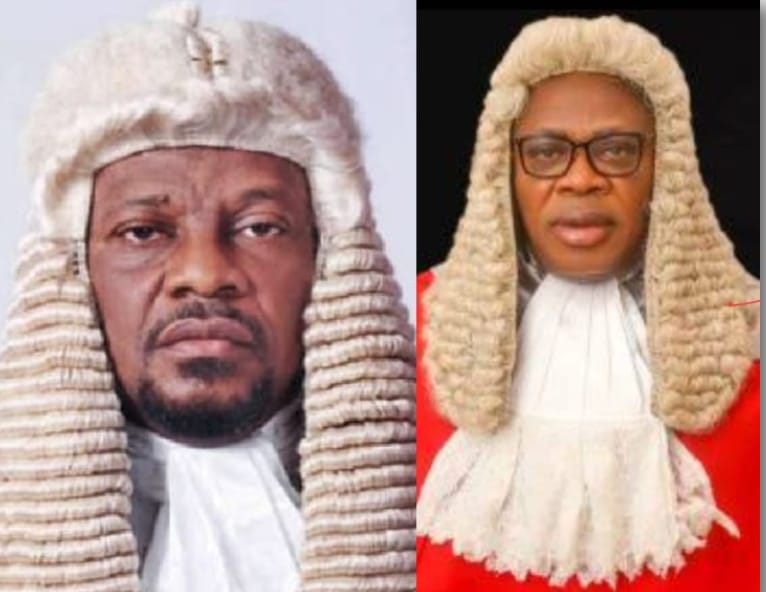
Rivers State Assembly and the Chief Judge’s Refusal to Constitute a Probe Panel: A Legal Appraisal of Governor Fubara’s Second Impeachment Crisis
By Sylvester Udemezue
Background
The second impeachment crisis involving Governor Siminalayi Fubara of Rivers State and his Deputy, Professor Ngozi Odu, is one of the most intense constitutional and political confrontations in the state’s recent history. It unfolded amid a prolonged power struggle between the executive and the Rivers State House of Assembly, raising fundamental questions about constitutional compliance, separation of powers, and the limits of judicial involvement in impeachment proceedings. The crisis formally crystallised on 8 January 2026, when the House of Assembly issued and purportedly served Notices of Allegations of Gross Misconduct on the Governor and his Deputy. The notices, signed by the Speaker, Hon. Martin Amaewhule, were supported by 26 members of the Assembly. Soon after, however, the process became mired in controversy over service and procedure. Reports indicated that several days after the resolution, the Governor had not been personally served with the notice, fuelling speculation about procedural defects, political manoeuvring, or a stalled process. There were also fears about whether the four Honourable members loyal to Governor Fubara were carried along as required by the proviso to Section 188(2) of the Constitution. On 16 January 2026, twenty-six (26) members of the House passed a Motion resolving to investigate the allegations and, directed the Speaker to request the Chief Judge of Rivers State to constitute a seven-man investigative panel, thereby escalating the crisis to a critical constitutional stage. However, a turning point occurred on 20 January 2026, when the Chief Judge, Hon Justice Amadi, declined the Assembly’s request to constitute the panel. In a letter responding to the Speaker’s request under section 188, the Chief Judge cited concerns relating to judicial independence and procedural propriety. This refusal introduced a novel constitutional dilemma: whether a Chief Judge has discretion to decline a request that appears constitutionally mandated, and the legal consequences of such refusal for an ongoing impeachment process. It is this tension between constitutional text, institutional roles, and political reality that this article interrogates. By examining the impeachment proceedings against Governor Fubara and his Deputy (particularly the Chief Judge’s refusal to constitute a probe panel), the article assesses the legality, propriety, and constitutional implications of the actions of the key actors within Nigeria’s impeachment framework.
A Summary of the Impeachment Procedure Under Section 188 of the Constitution
Impeachment proceedings against a Governor or Deputy Governor under section 188 of the 1999 Constitution are governed by a strictly sequenced and mandatory procedure, with which exact compliance is constitutionally required. The process begins with a Notice of Allegation of Gross Misconduct, which must be in writing, contain detailed particulars, be signed by not less than one-third of the members of the House of Assembly, and be presented to the Speaker. Upon receipt, the Speaker must, within seven (7) days, serve the Notice on the Governor and circulate copies to all members of the House. At this stage, “gross misconduct” is defined by section 188(11) as a grave violation or breach of the Constitution, or any misconduct which, in the opinion of the House, amounts to gross misconduct. The Governor is entitled to respond, and any reply must be circulated by the Speaker to all members before further steps are taken. Within fourteen (14) days of the presentation of the Notice (whether or not a reply is submitted) the House must decide, by motion and without debate, whether to investigate the allegations. This motion must be supported by not less than a two-thirds majority of all members; failure to attain this majority automatically terminates the process. Where the motion succeeds, the Speaker must, within seven (7) days, request the Chief Judge to constitute a seven-member investigative panel composed of persons of unquestionable integrity who are not members of the public service, the legislature, or any political party. The panel must conduct its inquiry in accordance with procedures prescribed by the House, afford the Governor the right to defend himself personally or through counsel, and submit its report within three (3) months of appointment. Upon receipt of the report, the House proceeds to final consideration. If the panel exonerates the Governor, the Constitution bars any further proceedings. If the allegations are upheld, the House must, within fourteen (14) days, consider and, by a two-thirds majority resolution, adopt the report, whereupon the Governor is removed from office with immediate effect. Throughout, strict compliance with section 188 is mandatory. While courts will not examine the merits of the allegations, they retain jurisdiction to intervene for procedural non-compliance, as affirmed by the Supreme Court in Inakoju v. Adeleke (2007) 4 NWLR (Pt. 1025) 423.
The Ouster Clause and the Justiciability of Impeachment Proceedings In Nigeria
Questions on impeachment under the Nigerian Constitution often generate confusion because two related but distinct issues are conflated: the constitutional power to impeach and the constitutional procedure for impeachment. This distinction was authoritatively settled by the Supreme Court in Inakoju v. Adeleke (2007) 4 NWLR (Pt. 1025) 423 (the Ladoja case), the leading authority on the justiciability of impeachment proceedings in Nigeria. In the case, which arose from the impeachment of Oyo State Governor Rasheed Ladoja, the Supreme Court held that the purported impeachment was a nullity due to flagrant non-compliance with section 188 of the 1999 Constitution. The Court affirmed that although impeachment is a political process, it is constitutionally regulated, and any departure from the prescribed procedure renders the entire exercise void. The decision underscored the judiciary’s role in protecting constitutionalism and the rule of law. The Court drew a clear line between power and procedure. On the one hand, it held that courts lack jurisdiction to question the substantive power of a House of Assembly to initiate and carry out impeachment, as that power is expressly vested in the legislature by sections 143 and 188 of the Constitution. The motives, wisdom, or political justification for impeachment are matters exclusively within the legislative domain. On the other hand, the Court held that the judiciary retains jurisdiction to inquire into allegations of non-compliance with the mandatory procedural steps in sections 143 or 188(1)–(9). Impeachment is therefore justiciable to the limited extent of ensuring strict adherence to constitutional procedure. In this context, the Supreme Court interpreted the ouster clauses in sections 143(10) and 188(10) as excluding judicial review only of the substantive resolutions or opinions of the House (such as whether conduct amounts to “gross misconduct”) but not of procedural compliance. Where constitutional safeguards are breached, the courts are both competent and duty-bound to intervene. Accordingly, impeachment under the Nigerian Constitution is not a non-justiciable political question in cases of procedural irregularity; the courts act as constitutional gatekeepers while refraining from adjudicating the political merits of the allegations. Thus although legislative acts are generally non-justiciable, courts will assume jurisdiction where the Constitution prescribes a specific procedure and that procedure is breached, as the courts are guardians of the Constitution.
Competence of the High Court of Rivers State in Impeachment-Related Proceedings
The High Court of Rivers State is competent (it shares concurrent jurisdiction with the Federal High Court) to entertain matters arising from impeachment proceedings against the sitting Governor of the State, not to determine the merits of the allegations, but to adjudicate issues of constitutional compliance and legal rights. Under section 272 of the Constitution of the Federal Republic of Nigeria, 1999, the State High Court has broad jurisdiction over civil proceedings involving the existence, extent, or enforcement of legal rights, powers, duties, or obligations, subject only to the exclusive jurisdiction of the Federal High Court under section 251. Accordingly, where impeachment proceedings raise questions of compliance with the mandatory procedures in section 188 of the Constitution, such disputes fall within the supervisory jurisdiction of the State High Court or the Federal High Court, which may enforce constitutional safeguards and the rule of law without intruding into the political discretion of the House of Assembly.
Legal Propriety (or Otherwise) of the Rivers State Chief Judge’s Refusal to Constitute a Probe Panel.
(a). Is the Chief Judge Bound to Constitute A Panel: The duty of a State Chief Judge to constitute an investigative panel under section 188(5) of the Constitution is neither mechanical nor automatic. It is a constitutional duty conditioned on prior strict compliance by the House of Assembly with the mandatory steps in section 188(1)-(4). Although the power to initiate impeachment and request a panel lies with the House, the Chief Judge’s role must be exercised in fidelity to the Constitution. As the Supreme Court held in Inakoju v. Adeleke (2007) 4 NWLR (Pt. 1025) 423, impeachment is a constitutionally regulated process, and any step taken in breach of constitutional requirements is a nullity. The Chief Judge therefore cannot be compelled to act on a constitutionally defective request, as the Constitution does not mandate participation in an unlawful or incomplete impeachment process. The Chief Judge is entitled, indeed constitutionally obliged, to decline a request where it is apparent that the House has failed to comply with fundamental procedural requirements under section 188, even absent a court order. This duty flows from sections 1(1) and (2) of the Constitution, which proclaim constitutional supremacy and bind all authorities to its provisions. To constitute a panel in the face of clear breaches (such as improper service, failure to secure the required majority, or premature invocation of section 188(5)) would amount to aiding a constitutional violation and undermining the rule of law. The proper course is to notify the Speaker of the defects and insist on due process. As affirmed in Inakoju v. Adeleke, procedural non-compliance vitiates impeachment ab initio. Where the Chief Judge declines on this basis, the House’s remedy lies in challenging that decision in court. In Abiodun v. C.J. Kwara State (2007) LPELR-8308(CA), the Court of Appeal confirmed that courts may examine both compliance with the two-thirds requirement and the Chief Judge’s exercise of discretion in empanelling a panel where challenged.
(b). Duty To Decline Where a Subsisting Court Order Exists: One of the reasons offered by the CJ of Rivers State for declining to set up a panel is that his office was in in receipt of two separate interim orders issued by the High Court on 16 January 2026 in Suit No.: OYHC/6/CS/2026 (Ngozi Odu v. Amaewhule & 32 Ors) and Suit No.: OYHC/7/CS/2026 (Siminalayi Fubara v. Amaewhule & 32 Ors). In both suits, the Honourable Chief Judge of Rivers State is named as the 32nd Defendant/Respondent, and the said interim orders were duly served on the CJ’s office on 16 January 2026, the same date on which the orders were issued. It is respectfully submitted that the Chief Judge is constitutionally bound to refuse to constitute a panel where a subsisting court order restrains further steps in the impeachment process. Obedience to court orders is a foundational element of the rule of law: all orders (whether regular, irregular, valid, or later found to be without jurisdiction) must be obeyed until set aside. This principle has been consistently affirmed by the Supreme Court, including in Rossek v. A.C.B. Ltd. (1993) 8 NWLR (Pt. 312) 382; Oba Aladegbemi v. Oba Fasanmade (1988) 3 NWLR (Pt. 81) 129; Adebayo v. Johnson (1969) 1 All NLR 176; Komolafe v. Omole (1993) 1 NWLR (Pt. 268) 213; and Oshiomhole v. FGN (2004) LPELR-5188(CA), echoing Hadkinson v. Hadkinson and Isaacs v. Robertson. Acting in defiance of a subsisting order would amount to contempt of court and a violation of constitutional supremacy under section 1(2). This position finds practical precedent in Ondo State, where the Chief Judge, Honourable Justice Olusegun Odusola, on 06 October 2023 declined to constitute a panel in obedience to a subsisting restraining order of the Federal High Court in FHC/ABJ/CS/1294/2023, thereby upholding judicial authority. The Rivers State Chief Judge in the present instance relied on Dele Abiodun v. Honourable Chief Judge of Kwara State (2007) 18 NWLR (Pt. 109) 169, where the Court of Appeal nullified an impeachment process because the Chief Judge had constituted a panel in defiance of a court order, sternly condemning such conduct and reaffirming the Chief Judge’s paramount duty to obey and uphold the law.
The Rivers House of Assembly and Quod Approbo Non Reprobo
A critical feature of this matter is the Rivers State Chief Judge’s statement to the Speaker that the House had lodged an appeal against the subsisting interim orders of the High Court, and that he had been served with the Notices of Appeal. He accordingly invoked the doctrine of lis pendens, noting that both parties and the court must await the outcome of the appeal. This is legally significant. Once a court order is made and remains subsisting, it binds all affected persons and authorities until set aside by due process. No litigant may approbate and reprobate in the same proceedings. Having itself appealed against the High Court’s order, the Rivers State House of Assembly cannot simultaneously proceed as if that order does not exist by requesting the Chief Judge to constitute an investigative panel. Such conduct violates the equitable principle of quod approbo non reprobo, which forbids a party from accepting and rejecting the same legal position to suit its convenience. By filing an appeal, the House has acknowledged the existence, binding force, and operative effect of the order, and is therefore legally and constitutionally bound to await the outcome of its appeal. It cannot lawfully take steps that undermine, pre-empt, or render nugatory a subsisting judicial decision.
Possible Legal Flaws that Could Justify Judicial Intervention
Judicial intervention is warranted where impeachment proceedings fail to comply with the mandatory procedural safeguards in section 188 of the Constitution. Such defects go to the root of the process and render it incompetent. Illustrative instances include the following:
- Failure by the Speaker to serve the Notice of Allegations on all members of the House, or to circulate the Governor’s reply (if any), as required by section 188(2), is a fundamental breach, as it deprives legislators of the opportunity to consider the Governor’s defence before further steps are taken.
- Where the motion to investigate is passed outside the mandatory fourteen (14) days from presentation of the Notice, or is not supported by a two-thirds majority of all members as required by section 188(4), the impeachment automatically fails.
- Non-compliance also arises where the Speaker’s request to the Chief Judge to constitute a seven-man panel is not made within seven (7) days of the resolution to investigate, contrary to section 188(5). Likewise, where a panel exonerates the Governor but the House nevertheless proceeds to remove him, such action is a nullity under section 188(8). An illustration occurred in Ekiti State during the Fayose episode, where a Governor was removed despite a panel’s exoneration, an illegality that went unchallenged;
- Even where a panel indicts the Governor, the process fails if the House does not, within fourteen (14) days, adopt the report by a two-thirds majority as required by section 188(9). This principle was applied in Plateau State, where the impeachment of Governor Joshua Dariye by only about 8 members (out of the 24-member House) was nullified and he was reinstated.
- Impeachment proceedings conducted outside the chambers of the House of Assembly are unconstitutional. In Inakoju & Ors v. Adeleke & Ors (2007) LPELR-1510 (SC), the Supreme Court nullified Governor Ladoja’s impeachment because proceedings were held at D’Rovans Hotel, Ibadan. Similarly, in Balonwu & Ors v. Obi & Anor (2007) LPELR-4255 (CA), Governor Peter Obi’s impeachment was set aside because, among other flaws, the proceedings occurred outside the Anambra State House of Assembly.
- In Dapianlong & Ors v. Dariye (SC 39/2007) [2007] NGSC 181, the Supreme Court held that section 188(10) does not oust judicial jurisdiction where there is non-compliance with sections 188(1)–(9). The impeachment of Governor Joshua Dariye was declared unconstitutional due to multiple fatal defects, including initiation and conduct by a minority of six to eight members in a twenty-four-member House; improper reliance on section 102; an undated and improperly signed Notice not served on the Governor or circulated to members; absence of valid two-thirds resolutions to investigate or adopt any report; an invalid request to the Acting Chief Judge; an improperly constituted panel that acted in defiance of subsisting court orders, submitted an interim report, and denied the Governor fair hearing; and proceedings conducted under coercive circumstances. Taken cumulatively, these violations rendered the impeachment, the panel proceedings, the report, and the purported removal null and void, necessitating the Governor’s reinstatement with all attendant rights and privileges.
Propriety of the Appeal Filed by the House of Assembly
The propriety of the House of Assembly’s appeal is open to serious doubt, given the nature of the order appealed against and settled procedural practice. The order in question was an interim ex parte order, which is inherently provisional and liable to be varied or set aside by the same court upon application. The more appropriate course would have been to apply promptly to the High Court to discharge or vary the order, while filing a counter-affidavit and written address in response to the pending motion on notice. Immediate appeals against ex parte orders are generally discouraged, as appellate courts emphasise that the court of first instance should first be given the opportunity to reconsider its interim ruling. Premature resort to appeal undermines judicial economy and risks unnecessary delay. More significantly, by appealing rather than first seeking to set aside the order, the House acknowledged the subsistence and binding effect of the order, thereby triggering the doctrine of lis pendens and constraining itself from taking steps that could render the order nugatory. Accordingly, while the appeal may not be incompetent, it was procedurally ill-advised and counterproductive in a sensitive constitutional process such as impeachment. A prompt application to set aside the ex parte order, coupled with a robust response to the motion on notice, would have better preserved the House’s position without attracting the constitutional and equitable consequences attendant upon appealing against a subsisting interim order.
A Word of Advice to the Warring Parties and the People of Rivers State
The protracted political crisis in Rivers State has reached a point of diminishing returns, where governance, public confidence, and institutional integrity are being sacrificed on the altar of political brinkmanship. As I advised in my earlier published write-up titled “Enough of the Rivers State Crisis: Nigerians are Tired of the Drama – It’s Time to Govern, not Grandstand”, the prevailing mood among Nigerians is one of fatigue and frustration with endless power struggles that yield no tangible benefit to the people. Nigeria faces far graver national challenges (insecurity, economic hardship, unemployment, and failing social services) than to be continually consumed by one state’s political quarrels. The warring political actors must recognise that constitutional power is held in trust for the public good, not as a weapon for perpetual conflict. All sides (executive, legislature, and their supporters) are urged to de-escalate tensions, respect constitutional boundaries, obey court orders, and prioritise dialogue, compromise, and statesmanship over confrontation. Ultimately, the peace, development, and welfare of Rivers State must take precedence over factional victories, as history is kinder to leaders who chose peace and delivered good governance than to those who merely grandstand loudly.
Conclusion
The impeachment crisis in Rivers State starkly illustrates the dangers of politicising constitutionally regulated processes and disregarding the rule of law. While impeachment is a legitimate constitutional mechanism, it must be exercised strictly within the confines of the Constitution, with scrupulous adherence to due process, judicial authority, and institutional restraint. Any deviation (whether by the legislature, the executive, or ancillary actors) invites judicial intervention and undermines democratic governance. The Constitution remains supreme, court orders remain binding, and no arm of government is above the law. It is only through fidelity to these foundational principles that constitutional democracy can be preserved and public trust restored in Rivers State and Nigeria at large.
Respectfully,
Sylvester Udemezue (Udems)
Legal Practitioner in Nigeria
udemsbackup@gmail.com.
(22 January 2026)