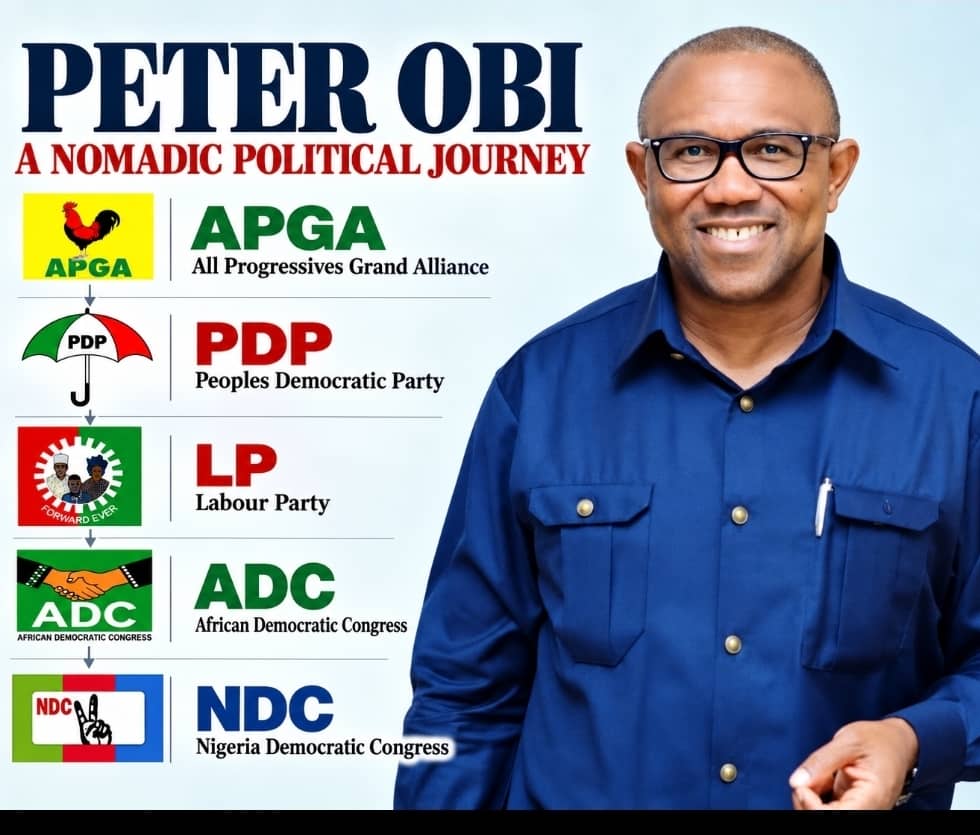
Peter Obi’s Political Nomadism As A Pattern of Habitual Escapism and Test of Presidential Readiness
By Halimat Ahouiza Aliu
Leadership is tested when agreement breaks down, interests collide and the easy options disappear. A politician who seeks responsibility for Nigeria must demonstrate the patience to manage conflict and the resolve to pursue solutions under pressure. Peter Obi’s repeated changes of political platform cast serious doubt on those qualities. In my assessment, his recent departures reveal a troubling preference for escaping difficult political environments over demonstrating that he can repair them. The objection goes beyond the number of party cards he has held. It concerns the relationship between his promise to rescue Nigeria and his response when the organisations through which he seeks power become difficult to manage. A presidential aspirant cannot reasonably ask citizens to disregard that relationship. Managing disagreement is part of leadership itself.
Obi’s documented journey runs from the All Progressives Grand Alliance (APGA) to the Peoples Democratic Party (PDP), then to Labour Party (LP), the African Democratic Congress (ADC), and the Nigeria Democratic Congress (NDC). His October 2014 move to the PDP was explained as a means of participating more effectively in national affairs. Channels Television recorded him saying that it was not about developments within APGA.[1] That earlier move establishes the wider pattern of migration; the stronger evidence of withdrawal in response to difficulty lies in his subsequent explanations.
In May 2022, Obi resigned from the PDP and withdrew from its presidential primary. His letter said developments within the party made continued participation and constructive contributions practically impossible.[2] By 30 May, he had secured Labour’s presidential ticket after the other three aspirants stepped down.[3] On 31 December 2025, he publicly declared for the ADC, which welcomed him as part of its national political project.[4] On 3 May 2026, he joined the NDC alongside Rabiu Kwankwaso.[5]
Explaining the ADC departure, Obi cited internal disputes and litigation, expressly drawing a parallel with his reasons for leaving Labour. He also alleged that these difficulties had been deliberately orchestrated to obstruct his participation.[6] His account supplies the central issue: successive platforms became embroiled in difficulties, and he chose to leave. Those departures are documented. My criticism is that their repetition amounts to a pattern of political escapism that weakens his claim to presidential readiness.
The first reason is the absence of a convincing demonstration of institutional repair. Leaving a troubled organisation may protect a politician’s immediate electoral prospects, but it does not demonstrate that he can reconcile its factions, restore confidence or establish workable procedures. Obi’s explanation tells Nigerians why he considered remaining difficult. It does not, by itself, show what sustained remedial effort he made, why it failed or why further effort was futile. A candidate offering national rescue owes voters that fuller account.
Second, his response risks turning adversity into a reason for abandoning responsibility. A reformer should expect resistance from entrenched interests and disagreement even among allies. If internal hostility is sufficient reason to leave one platform after another, what practical assurance exists that he can persevere through the frustrations of national reform? Good intentions are inadequate where the central requirement is the ability to organise people who do not readily agree.
Third, repeated departures raise questions about political judgment before the crises occur. Each new alliance requires an assessment of its leadership, procedures and compatibility with the candidate’s programme. If another supposedly suitable platform soon becomes unworkable, voters may reasonably question the quality of that assessment. The short interval between Obi’s public ADC declaration and NDC entry makes this concern particularly difficult to dismiss.[4][5] Presidential judgment must extend beyond identifying the next available electoral vehicle.
Fourth, his stated concern about external interference does not settle the leadership question. The allegation requires evidence; it should not be presented as an established finding. Even if interference occurred, however, a politician promising far-reaching reform must explain how he intends to resist obstruction. Otherwise, those seeking to frustrate him could determine his direction merely by generating another dispute. Moving away from pressure can preserve an ambition while leaving the underlying problem unresolved.
Fifth, the pattern raises a question about commitment to institutions beyond personal candidature. Supporters devote time, resources and credibility to building local organisations. When the principal figure moves on, they must decide whether to follow, remain or abandon their work. Such transitions may be justified, but each requires an account of the collective benefit. The opportunity to remain a presidential candidate is not, on its own, proof that a departure advances institutional development.
The argument about party primaries deserves equally close attention. Obi withdrew from the PDP presidential contest in 2022; Labour’s other aspirants subsequently stepped down before he secured its ticket; and in May 2026, the NDC cleared him as its sole presidential aspirant.[2][3][7] These facts support criticism of a preference for less competitive nomination routes. Although they do not establish as a fact that fear motivated his departures, the political implication is nevertheless serious.
Negotiating consensus can demonstrate skill, and an uncontested nomination is not inherently objectionable, but obtaining a ticket after competitors withdraw supplies different evidence from winning a difficult contest against determined rivals. Voters considering Obi for the presidency are entitled to ask how convincingly he has demonstrated the ability to persuade competing centres of power to accept his leadership when withdrawal or accommodation cannot be assumed.
To be clear, it would be inaccurate to say that he has never faced a contest or stood his ground. His Anambra tenure litigation reached the Supreme Court and secured protection of his full term from his assumption of office in March 2006.[8] That achievement deserves recognition. However, that does not answer the present criticism.
Persistence in defending a personal electoral mandate and patience in sustaining a divided political organisation are distinct leadership tests. Success in one cannot be treated as conclusive evidence of competence in the other. The presidency would expose any weakness in the latter capacity. A president must work with legislators, governors, public officials and citizens whose interests cannot simply be brought into alignment by announcing a new platform. Security decisions require coordination. Economic reform requires negotiation and public confidence. Disputes over priorities require choices that disappoint some allies. These are enduring responsibilities, and there is no alternative Nigeria to which a president can defect.
Although a political party and a country are different institutions, so party difficulties cannot mechanically predict presidential failure, yet parties provide a practical setting in which candidates can demonstrate negotiation, discipline and the management of competing ambitions. When a candidate repeatedly exits troubled platforms, the electorate loses an opportunity to observe those abilities. He must supply persuasive evidence of them elsewhere; promises of a better future do not fill that gap.
For these reasons, I regard Obi’s repeated departures as evidence against his readiness to lead Nigeria through sustained adversity. The case is strongest when stated as a judgment about his conduct, not any claim about his private fears. Obi’s record invites the conclusion that, in recent party crises, changing the arena has taken precedence over demonstrating that he can resolve the conflict within it. Nigerians should demand more from anyone seeking their highest office. The true test of pragmatic leadership is the ability to face a difficult situation, organise a credible response and remain accountable for the outcome. Obi must show why his pattern of departure or escapism should inspire confidence in that capacity. Until he does, his political peregrinations provide substantial grounds for withholding the presidency from him. Nigeria’s challenges require sustained leadership; another change of platform cannot resolve them.
Halimat Ahouiza Aliu is a Research Assistant with The Reality Ministry of Truth Law and Justice (TRM), and can be reached on mails@therealityministry.ngo.
REFERENCES
[1] Channels Television, “Former Anambra Governor Peter Obi Joins PDP”, 7 October 2014.
https://www.channelstv.com/2014/10/07/former-anambra-governor-peter-obi-joins-pdp/
[2] The PUNCH, “Why I quit PDP, presidential primary – Peter Obi”, 25 May 2022.
[3] Akinola Ajibola, “UPDATED: Peter Obi Emerges Labour Party Presidential Candidate”, Channels Television, 30 May 2022.
https://www.channelstv.com/2022/05/30/breaking-utomi-steps-down-for-obi-as-labour-party-holds-presidential-primary/
[4] African Democratic Congress, “ADC Welcomes Peter Obi as He Officially Joins the Party”, official account of the 31 December 2025 declaration.
https://www.adc.org.ng/news-single/adc-welcomes-peter-obi-as-he-officially-joins-the-party
[5] Channels Television, “Obi, Kwankwaso Join NDC, Receive Membership Cards”, 3 May 2026, subsequently updated.
https://www.channelstv.com/2026/05/03/obi-kwankwaso-join-ndc-receive-membership-cards/
[6] Gilbert Ekugbe, “Why I left ADC — Peter Obi”, The PUNCH, 4 May 2026.
[7] Imoleayo Oyedeyi, “PHOTOS: NDC screening committee clears Obi as sole presidential aspirant”, TheCable, 20 May 2026.
https://www.thecable.ng/photos-ndc-screening-committee-clears-obi-as-sole-presidential-aspirant/
[8] Obi v Independent National Electoral Commission and Others, SC 123/2007, Supreme Court judgment, 2007, full reasons reproduced by Sheriahub.
https://sheriahub.com/cases/ng/caselaw/peter-obi-v-independent-national-electoral-commission-ors-sc-12320072007-ngsc-51-13-july-2007