THE TRANSFORMATION OF THE FCT, ABUJA, UNDER PRESIDENT BOLA AHMED TINUBU’S ADMINISTRATION: MYTH OR REALITY?
By Sylvester Udemezue
(1). INTRODUCTION
Public discussions about governance in Nigeria are too often reduced to partisan extremes. Once an individual supports a government, some people assume that everything he says must be propaganda. Conversely, once a person opposes a government, some believe that acknowledging any achievement of that government amounts to political betrayal. This approach does not promote honest public discourse. It prevents Nigerians from facing issues objectively and assessing governments on the basis of verifiable evidence.
The relevant question is therefore not whether one likes President Bola Ahmed Tinubu, the Minister of the Federal Capital Territory, Nyesom Wike, or the political parties to which they belong. The proper question is whether the Federal Capital Territory has experienced substantial and measurable development since the Tinubu administration assumed office on 29 May 2023.
Roads do not belong to political parties. Bridges do not vote. Water pipelines cannot be persuaded by propaganda. A railway either operates or it does not. A road either exists or it does not. A completed public facility can be inspected, photographed and used by the public. Judged by this objective standard, the transformation of the Federal Capital Territory under President Tinubu is not a myth. It is a physical, visible and verifiable reality. This does not mean that every problem in Abuja has been solved, that every project was conceived by the present administration, or that every expenditure must be accepted without scrutiny. It simply means that denying the extensive transformation taking place across the FCT would amount to denying the credible evidence before us.
(2). WHAT SHOULD QUALIFY AS TRANSFORMATION?
Transformation does not mean perfection. No responsible person should suggest that Abuja has suddenly become a perfect city or that every community in the FCT now enjoys adequate roads, water, electricity, housing, sanitation, transportation, education, healthcare and security. Transformation means a substantial change in the condition, functionality, accessibility and developmental direction of a place. It can be measured through the completion of previously abandoned projects; the construction of new roads and bridges; the rehabilitation of deteriorated infrastructure;
the extension of development to neglected communities; the restoration of public transportation; the expansion of water and other essential services; the improvement of public institutions and facilities; and the opening of new districts for residential and commercial development.
Before the present administration, Abuja was widely confronted by abandoned projects, deteriorating roads, dark streets, flooding, weak public transportation, poor sanitation and insufficient development in its satellite communities. A detailed assessment published when the present FCT Minister assumed office identified many of these problems as urgent challenges requiring decisive intervention. It is against that background that the performance of the Tinubu administration must be assessed.
(3). THE REVIVAL AND COMPLETION OF MAJOR CITY-CENTRE PROJECTS
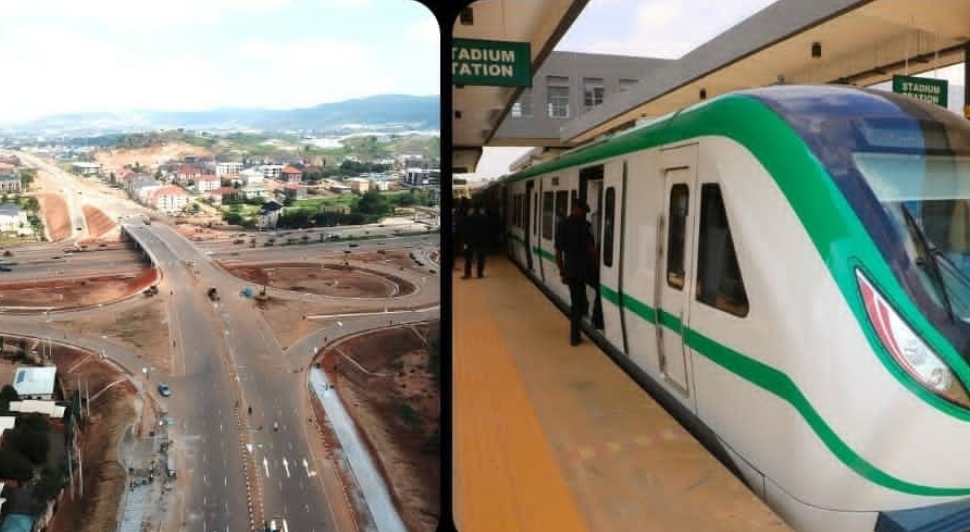
One of the clearest features of the present administration is its emphasis on completing projects that had remained unfinished for several years. The Southern Parkway is a good example. It was awarded in 2010 as a major artery intended to open the southern development flank of Abuja. However, it remained incomplete until the intervention of the Tinubu administration, which completed and inaugurated it in May 2024. The administration also completed and inaugurated Arterial Road N20, now known as Wole Soyinka Way, linking the Northern Parkway with the Outer Northern Expressway. The road forms an important part of the network connecting the northern and southern sections of the capital city. Other major interventions have included the Inner Southern Expressway extension, the engineering infrastructure in Guzape District, the rehabilitation of numerous roads in Maitama, Wuse, Garki, Wuye and other districts, and the development of strategic interchanges and access roads.
In June 2025, the administration commissioned Arterial Road N16, also known as Shehu Shagari Way, connecting Ring Road I to Wole Soyinka Way, together with associated interchanges and feeder roads serving Maitama, Jahi, Mabushi and adjoining districts. In June 2026, the full-scope development of Arterial Road N5, Obafemi Awolowo Way, connecting Life Camp Junction to Ring Road III in Dape District, was inaugurated. The corridor improves connections among Dape, Karmo, Gwarinpa, Kado, Idu, Mbora and the Idu Industrial District. The newly constructed Collector Road C01 and its bridge within the Institution and Research District were also commissioned in July 2026, further opening the district for institutional, residential and commercial development. These are not imaginary projects. They are physical infrastructure that residents and visitors can inspect and use.
(4) THE ABUJA METRO: FROM ABANDONMENT TO OPERATION
The restoration of the Abuja Rail Mass Transit system is another important achievement. The rail project was not originally conceived or constructed by the Tinubu administration. It was commissioned in 2018 but later became largely non-functional following the COVID-19 disruption, vandalism and the absence of essential access infrastructure. Rather than pretend that the project was newly conceived, President Tinubu publicly acknowledged that his administration inherited it. What the administration did was provide the funding, access roads, rehabilitation and administrative support required to return it to commercial operation. Commercial services were relaunched on 29 May 2024. The FCT Administration also constructed access roads and car parks serving the stations and settled outstanding obligations necessary for the system’s resumption.
This distinction is important. The conception of the railway belongs to previous administrations. However, the political decision, financing and executive action that restored it to operation deserve to be credited to the present administration. Government is a continuum. A new government is not required to abandon a useful project merely because another government initiated it. Indeed, one of the most responsible things an administration can do is to identify beneficial inherited projects, fund them and complete them for public use.
(5). DEVELOPMENT IS NO LONGER CONFINED TO MAITAMA, ASOKORO AND THE CENTRAL AREA
Perhaps the strongest evidence against the claim that the transformation is merely political propaganda is the spread of projects into the satellite towns and Area Councils. For decades, residents outside Abuja’s central districts complained that development was concentrated in Maitama, Asokoro, Wuse, Garki and the Central Business District, while communities in the Area Councils were largely neglected.That pattern is gradually changing. In June 2025, the administration inaugurated the 15-kilometre A2–Pai Town Road in Kwali Area Council. By that period, the FCT Administration reported that road projects covering about 150 kilometres had either been completed or were under construction across the six Area Councils.
Among the completed roads expressly identified were: the nine-kilometre Paikon-Kore–Ibwa Road in Gwagwalada; the five-kilometre Gaba–Tokulo Road and bridge in Bwari; the five-kilometre road from Tipper Garage Junction to the LEA Secretariat in Kuje;
the eleven-kilometre Yangoji–Sukuku–Ebo Road in Kwali; the Saburi I and II Road in the Abuja Municipal Area Council; and the Aguma Palace–Radio Nigeria–New Market Road in Gwagwalada. The 16.4-kilometre dualisation and upgrading of the Ushafa–War College–Army Checkpoint corridor, together with ancillary roads in Bwari Area Council, were subsequently commissioned.
These projects have direct implications for farming, local trade, school attendance, security response and access to healthcare. In June 2026, the Airport Expressway–Kuje Township Junction road was also inaugurated. The project is designed to reduce travel time between Kuje and the Abuja city centre and to improve access to other major highways within the FCT. One may debate the political motives of those executing these projects. What is difficult to debate is whether the projects exist.
(6). WATER INFRASTRUCTURE AND OTHER PUBLIC FACILITIES
The FCT transformation is not restricted to roads. In June 2025, the Greater Abuja Water Supply Network (comprising Loops 1, 2, 5 and 6) was commissioned. The project was designed to improve the distribution of treated water to homes, institutions and developing districts across the capital. In June 2026, the administration commissioned more than 194 kilometres of secondary and tertiary water pipelines serving Karu, Orozo, Jikwoyi, Kurudu and adjoining communities. The project was designed to connect over 1,000 distribution lines and extend treated water to satellite communities that had depended substantially on private boreholes and water vendors.
The administration has also intervened in judicial and public institutional infrastructure although I peraonally do not think judicial infrastructure should be undertaken by the executive arm in a country that professes to uphold independence of the judiciary (a discussion for another day). In June 2026, a new Court of Appeal complex for the Abuja Division was commissioned in Dakibiyu. Before the intervention, the division operated with only two courtrooms in an inadequate temporary facility. The new complex is expected to provide a more suitable environment for the administration of justice. There have also been interventions involving judicial residences, the National Assembly complex, the Federal Secretariat, educational institutions, bus terminals, security facilities and public buildings. Accordingly, while road construction remains the most visible part of the transformation, it is not the only component.
(6). “THE PROJECTS WERE INHERITED” – IS THAT A VALID OBJECTION?
Some critics argue that several of the projects being commissioned were inherited from previous administrations. That observation is partly correct, but the conclusion usually drawn from it is mistaken. Public projects have different stages: conception; design; approval; award; mobilisation; funding; construction; completion; and operation and maintenance. One administration may conceive and award a project, while another provides the decisive funding and executive supervision necessary to complete it.
The Southern Parkway was awarded in 2010 but completed under President Tinubu. The Abuja Metro was conceived and substantially constructed before Tinubu assumed office, but the present administration provided the intervention that returned it to commercial operation. The administration has openly acknowledged these facts. Therefore, the present government should not claim exclusive credit for conceiving every inherited project. Nevertheless, it is entitled to credit for funding, completing and making such projects functional. Completing an abandoned project is not theft of another administration’s achievement. It is responsible governance.
Indeed, Nigeria’s development has suffered greatly because successive administrations sometimes abandon valuable projects merely because they were initiated by their predecessors. The decision to complete inherited projects should be encouraged, not condemned.
(7). THE FCT’S REMOVAL FROM THE TREASURY SINGLE ACCOUNT
Another argument commonly advanced is that the Federal Capital Territory Administration is no longer operating within the Treasury Single Account and that this must necessarily mean that corruption is taking place.
This reasoning is unsustainable. President Tinubu approved the removal of the FCT Administration from the Treasury Single Account framework. He subsequently explained that the decision was intended to reduce bureaucratic delays and give the FCT greater flexibility to fund infrastructure and respond to its developmental obligations.
However, a Treasury Single Account is a cash-management arrangement. It is not a divine guarantee of honesty. The fact that an institution operates under the TSA does not make corruption impossible. Similarly, the fact that the FCT operates outside the TSA does not, by itself, establish corruption.
The relevant questions should be: Were contracts properly approved and procured? Were the projects actually executed? Were the costs reasonable? Did the public receive value for money? Were payments properly documented? Are the accounts independently audited? Can citizens and oversight institutions examine the relevant records?
These are legitimate questions.
The National Assembly passed an FCT statutory budget of approximately ₦2.285 trillion for 2026, with about ₦1.741 trillion—or 76.19 per cent—allocated to capital expenditure. The budget also contained specific provisions for engineering services, education, satellite-town development, resettlement and compensation. A capital-heavy budget helps to explain the volume of ongoing projects, but a budgetary allocation is not, by itself, proof of prudent expenditure. Transparency, competitive procurement, auditing and legislative oversight must remain essential.
I support no corruption and will defend no corrupt public official. If anyone has credible evidence that the FCT Minister or any other official has diverted public funds, inflated contracts, received unlawful benefits or otherwise violated the law, such evidence should be presented to the appropriate institutions, including the EFCC, the ICPC, the National Assembly, the Auditor-General or the courts. However, allegation is not proof. Political hostility is not an audit report. The removal of the FCT from the TSA cannot, without more, be treated as conclusive evidence that its officials are corrupt.
(9). LEGITIMATE CRITICISMS MUST NOT BE DISMISSED
Acknowledging the transformation of Abuja does not require anyone to suspend critical reasoning. For example, the reported ₦39 billion expenditure on the renovation of the Abuja International Conference Centre attracted questions about cost, transparency and value for money. The FCT Minister defended the expenditure by explaining that the renovation involved a comprehensive replacement of virtually every component except the main block structure. Nevertheless, citizens are entitled to seek detailed information about the scope of work, procurement process, contract valuation and final expenditure.
Similarly, the enforcement of the Abuja Master Plan and demolition of allegedly unlawful structures must be undertaken with strict regard for due process, valid titles, court orders, proper notice, compensation and resettlement where legally required. In December 2024, the Senate directed that demolitions not authorised by a court be suspended while it investigated complaints concerning the exercise.
Development must be firm, but it must also be humane. A road project cannot justify an unlawful demolition. Urban renewal should not become an excuse for arbitrariness. Citizens should not lose their homes or livelihoods without due process merely because the government is pursuing a beautification or infrastructure programme. There are also unresolved service-delivery challenges. Reports from communities such as Nyanya and Karshi have highlighted poor waste evacuation and the health risks created by accumulated refuse. These shortcomings demonstrate that the transformation is incomplete. They do not establish that it is imaginary.
(10). MYTH, EXAGGERATION OR REALITY?
Three distinct positions must not be confused. The first is the claim that no meaningful development has taken place in the FCT under President Tinubu. That claim is demonstrably false. The second is the suggestion that every problem in Abuja has been solved, every project was initiated by the present administration and every expenditure is necessarily beyond question. That position would also be inaccurate. The third (and most reasonable) position is that the Tinubu administration, working through the FCT Administration led by Nyesom Wike, has significantly accelerated the completion of abandoned projects, initiated new infrastructure, restored important public facilities and expanded development into several satellite towns and Area Councils. That is the position most consistent with the available evidence.
One may disagree with President Tinubu’s economic policies. One may dislike the FCT Minister’s political style. One may belong to an opposition party. One may even decide never to vote for either of them. None of these positions can make a completed road disappear, return an operating railway to abandonment, remove a bridge or erase kilometres of newly installed water pipelines.
Facts do not become false merely because they favour one’s political opponent.
(11). CONCLUSION
The transformation of the Federal Capital Territory under President Bola Ahmed Tinubu is a reality; not a myth. It is visible in the Southern Parkway, Wole Soyinka Way, Shehu Shagari Way, Obafemi Awolowo Way, the Abuja Metro, the Kuje and Bwari roads, the roads across Gwagwalada, Kwali and other Area Councils, the Greater Abuja Water Supply Network, the Karu water-distribution system, the Court of Appeal complex and numerous other completed or ongoing projects. This conclusion does not place the administration above criticism. It does not excuse waste, corruption, arbitrary demolitions, defective procurement, inadequate compensation or neglect of essential services. On the contrary, the scale of public expenditure makes transparency and accountability even more important. The intellectually honest position is therefore neither blind praise nor blind denial. It is to acknowledge what has been achieved, identify what remains undone, demand value for every naira spent and insist that development be lawful, inclusive, sustainable and humane. A citizen may support President Tinubu and still demand transparency. A citizen may oppose him and still acknowledge that Abuja has changed. That is what it means to face issues rather than personalities. The transformation is real. It is substantial. It is measurable. It remains incomplete. And it must continue to be subjected to the scrutiny required in every constitutional democracy.
Respectfully,
Sylvester Udemezue (Udems)
Proctor,
The Reality Ministry of Truth Law and Justice (TRM)
08021365545.
udems@therealityministry.ngo.
(02 August 2026)