PRAGMATIC PROGRESSIVISM: Governor Soludo, President Tinubu and the Promise of Cross-Party Cooperation In Nigerian Politics
By Sylvester Udemezue
INTRODUCTION: A POLITICAL MOMENT WORTH EXAMINING
Nigeria’s political development will be better served when disagreement does not automatically foreclose cooperation. This proposition has acquired fresh significance in the approach to the 2027 presidential election, particularly through the public support expressed for President Bola Ahmed Tinubu by prominent political figures associated with parties other than the All Progressives Congress (APC). Among them, Governor Chukwuma Charles Soludo of Anambra State offers an instructive example.
At the inauguration of the APC Presidential Campaign Council at the Banquet Hall, State House, Abuja, in October 2026, Soludo’s intervention placed emphasis on national unity, security and shared prosperity while signalling support for Tinubu’s re-election. His position invites reflection on an emerging political idea that may usefully be described as “pragmatic progressivism”: the pursuit of broadly progressive public objectives through practical cooperation, including across party boundaries.
THE MEANING OF PRAGMATIC PROGRESSIVISM
Progressivism is concerned with improving society through purposeful reform, effective institutions, expanding opportunity, and a fairer distribution of the benefits of development. Pragmatism concerns the selection of workable means, informed by circumstances, evidence and consequences. Combined, the two concepts suggest that political actors should be judged not only by the labels they adopt but also by the public purposes they pursue and the results their choices are capable of producing.
Put simply, progressivism identifies the destination; pragmatism helps choose a practicable route. This does not require ideological surrender, party merger or universal agreement. It permits cooperation on defined objectives while preserving legitimate differences on other questions.
The expression is used here as an analytical description of a political approach, not as a claim that Soludo formally announced a settled doctrine bearing that precise name. Nor should every cross-party endorsement automatically be described as progressive: its substance, motives and consequences must still be examined.
SOLUDO’S INTERVENTION AND ITS WIDER SIGNIFICANCE
Soludo’s political home is the All Progressives Grand Alliance (APGA); Tinubu’s is the APC. Their distinct affiliations make the governor’s intervention noteworthy. It demonstrates that a politician may retain a party identity while reaching an independent judgment about a candidate sponsored by another party.
Soludo’s emphasis on unity, security and shared prosperity is particularly relevant. These objectives are not the exclusive property of any political organisation. They are national aspirations against which every administration may properly be assessed.
His intervention therefore offers a more substantial basis for understanding cross-party cooperation than mere political convenience: common goals can sometimes justify a common undertaking.
A COALITION WIDER THAN ONE PARTY
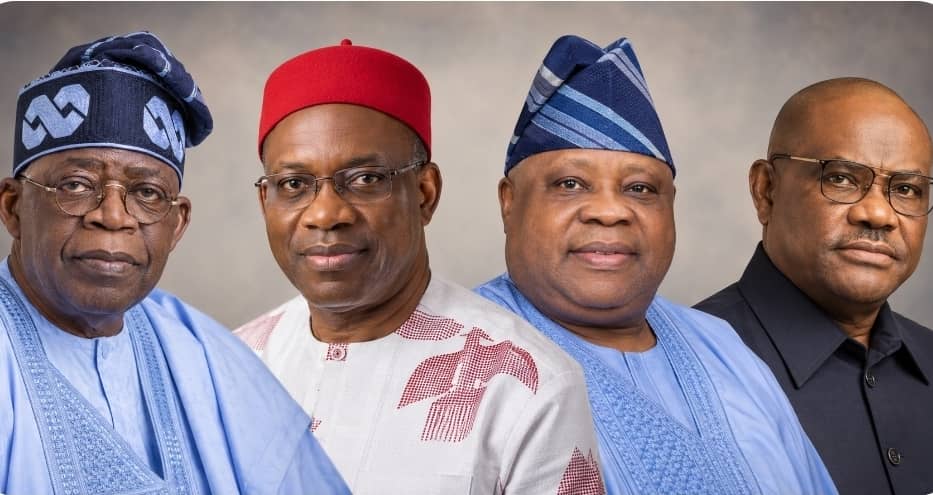
The wider political picture reinforces the point. Osun State Governor Ademola Adeleke, associated with Accord, and Nyesom Wike, a leading political figure associated with the Peoples Democratic Party (PDP), have also been identified with support for Tinubu’s re-election. These relationships differ in their histories and political circumstances.
What unites them for present purposes is the possibility of cooperation around a presidential candidacy without the complete disappearance of existing party affiliations. This approach reflects a practical feature of presidential politics: the candidate is sponsored by a party, but the electorate is larger than the party.
A credible national coalition must persuade people across regional, religious, ethnic, generational and partisan divisions. It cannot reasonably presume that a party label alone settles every voter’s judgment.
THE DEMOCRATIC VALUE OF CROSSING DIVIDES
Nigeria’s plural character makes constructive engagement especially valuable. No ethnic group, faith community, geopolitical zone or political party possesses a monopoly on patriotism, wisdom or progressive ideas. The possibility that leaders from different backgrounds may agree on a national objective should therefore be regarded as an ordinary feature of democratic maturity, not necessarily as a betrayal of identity.
Yet inclusion must be genuine. It should broaden participation rather than merely enlarge the list of prominent personalities at campaign events. A meaningful coalition makes room for divergent experiences, recognises local concerns and subjects its claims to public scrutiny.
The same democratic principle also protects those who decline to join. Opposition is legitimate. Voters must be free to assess Tinubu’s record, compare competing programmes and vote according to conscience. Pragmatic progressivism is most persuasive when it respects that freedom rather than seeking to extinguish political competition.
THE TEST BEYOND THE 2027 ELECTION
For Tinubu’s supporters, the emerging cross-party relationships offer a framework for arguing that continuity in leadership may assist the consolidation of reforms and the pursuit of longer-term objectives. The deeper promise of pragmatic progressivism extends beyond electoral arithmetic.
Cooperation among leaders of different parties may prove valuable in security, infrastructure, economic opportunity, education, institutional reform and the improvement of public services. If such cooperation survives the campaign season and produces demonstrable public benefits, it may help establish a more constructive political culture.
If, instead, it remains a temporary arrangement among influential personalities, its contribution to national development will be limited. Its credibility will ultimately be determined by conduct and results, not rhetoric.
CONCLUSION: COMMON PURPOSE WITHOUT COMPULSORY UNIFORMITY
Governor Soludo’s intervention at the campaign council inauguration deserves attention because it illustrates a simple but consequential political possibility: one may maintain a distinct party identity and nevertheless cooperate with others on a clearly defined national objective. The reported support of figures associated with Accord Party, the PDP and some other parties gives that possibility wider contemporary relevance.
President Tinubu’s emerging cross-party coalition can accordingly be understood through the lens of pragmatic progressivism, provided that the phrase denotes principled, transparent and accountable cooperation rather than expediency. Its central lesson is not that parties should cease to differ, but that difference need not always prevent agreement.
Nigeria needs both meaningful political competition and the maturity to recognise legitimate common ground. Where public purpose is clear, methods are lawful and citizens remain free to judge, cooperation across party, ethnic, religious and regional lines can strengthen rather than diminish democratic life. That, more than the breadth of any campaign council, is the enduring promise of pragmatic progressivism.
Respectfully,
Sylvester Udemezue (Udems)
udemsy@gmail.com
(20 October 2026)