ADAMS OSHIOMHOLE AND THE COURAGE TO MAKE A SENATE SEAT COUNT* (Meeting the Man Behind an Outstanding Legislative Voice)
By Sylvester Udemezue
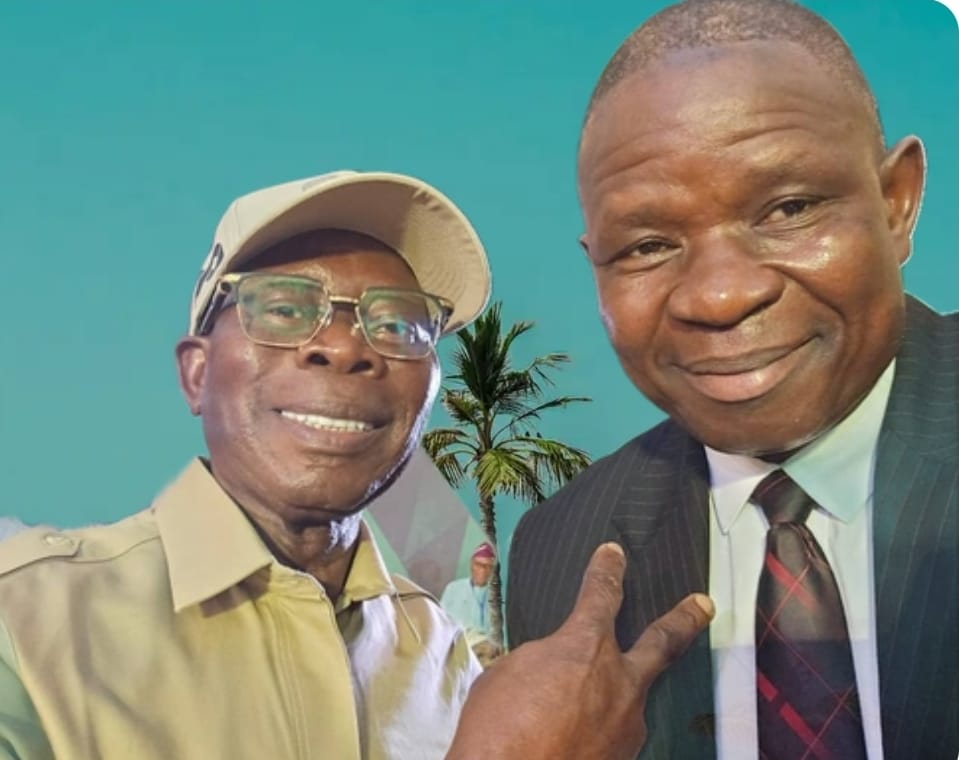
At the Banquet Hall of the State House, Presidential Villa, Abuja, sometime around mid October 2026, I finally met the man whose voice had so often held my attention in Senate debates. I spoke with Senator Adams Oshiomhole and found him remarkably easy-going and down-to-earth. The ease of our conversation stayed with me and prompted a closer reflection on the quality of his public service. As the senator representing Edo North, Oshiomhole has, in my assessment, distinguished himself as an outstanding legislator through the substance of his interventions on the Senate floor, his questioning at committee engagements and his willingness to insist that public officials explain themselves. His public voice is recognisable because it is direct, often uncomfortable and difficult to ignore. He has a gift for taking an official explanation and exposing the practical question beneath it. How does this proposal affect a worker? What does this expenditure actually purchase? How can lawmakers deliberate responsibly without the document before them? These are questions through which a parliamentary seat acquires public value.
Oshiomhole brings an unusually varied experience to the chamber. He served as President of the Nigeria Labour Congress from 1999 to 2007, Governor of Edo State from 2008 to 2016, and National Chairman of the All Progressives Congress from 2018 to 2020. Those roles exposed him to industrial negotiation, executive responsibility and the pressures of party organisation. My reading of his politics is that the labour organiser remains an important presence within the senator. He pays attention to the relationship between institutional power and people who must live with its decisions. His executive experience also gives him a basis for questioning the gap between a government’s stated intentions and its administrative performance. His style is combative and unmistakably partisan, yet several of his parliamentary interventions demonstrate a readiness to question proposals within institutions controlled by his own party. That is a useful quality in a legislature. Party membership carries responsibilities; the legislative mandate carries an obligation to examine what government brings before the people’s representatives.
My published assessments of Oshiomhole have included criticism. In September 2020, while questioning aspects of his political conduct, I urged Governor Godwin Obaseki to show magnanimity after his electoral victory, end the hostilities and concentrate on governance. In September 2024, I criticised reported remarks about Mrs Betsy Obaseki’s childlessness and argued for civility in political disagreement. Those positions reflected standards I continue to consider important. The same independence of judgment permits appreciation today. A public figure’s record deserves assessment across particular actions and circumstances. I can maintain my objections to a statement while recognising the value of his legislative work. Indeed, praise carries greater weight when it comes from someone prepared to disagree. The bluntness for which he is known gives his interventions force. At his best, he calls a spade a spade, even when doing so unsettles those listening. The most valuable expression of that instinct is his readiness to pursue an awkward public question until its substance becomes clear. Six areas of his Senate work illustrate the point.
(2). *Defending informed debate on the Senate floor*
On 20 October 2026, during consideration of the National Senior Secondary Education Commission Amendment Bill, Oshiomhole raised a procedural concern about the distribution of copies to senators. The Senate nevertheless advanced the bill through second reading and referred it for committee scrutiny. His intervention deserves attention because informed deliberation requires access to the text under consideration. For a lawmaker, asking to see the bill is an elementary duty with profound consequences. A worthy policy objective still requires careful examination of the provisions intended to achieve it. Oshiomhole’s objection placed that responsibility before the chamber. His contribution lay in insisting on the conditions for serious legislative work.
(3). *Bringing the concerns of vulnerable workers into debate*
During the Senate’s discussion of protection for domestic workers on 8 May 2024, Oshiomhole drew attention to serious abuses suffered by such workers, including sexual violence and harassment that often go unreported. He contributed to a debate on legislation sponsored by another senator, bringing the vulnerability of people working inside private homes into parliamentary consideration. In the May 2025 debate on Senator Sani Musa’s bill to regulate informal-sector employment agencies, he questioned whether licensing and outsourcing arrangements might worsen exploitation. The bill passed second reading and proceeded to committee. His warning introduced an essential test for the proposed framework: whether it would protect the worker in practice. These interventions show the value of experience carried into lawmaking. Regulation should be examined from the position of the person with the weakest bargaining power. Oshiomhole’s contribution was to keep that person in view while the Senate considered the machinery of recruitment and supervision.
(4). *Requiring credible documents at budget hearings*
On 17 January 2025, the National Assembly Joint Committee on Interior, co-chaired by Oshiomhole and his House of Representatives counterpart, Abdullahi Aliyu Ahmed, stepped down the Federal Fire Service’s budget defence. Lawmakers queried discrepancies in the documents, including truck pricing, contractual commitments and revenue evidence, and demanded a corrected submission. Here, scrutiny had an immediate consequence: the agency had to return with documents capable of proper examination. Oshiomhole and his colleagues insisted that the figures on paper must withstand questioning. Public money deserves precisely that seriousness.
(5). *Giving human meaning to budget figures*
As Chairman of the Senate Committee on Interior, Oshiomhole used a correctional-service budget hearing on 7 December 2023 to challenge the priorities disclosed by daily feeding provisions of ₦750 for an inmate and ₦800 for a security dog. He drew particular attention to people awaiting trial and pressed the importance of humane treatment and rehabilitation. The force of the intervention came from making an administrative figure understandable in human terms. A feeding allocation determines what a person in custody can eat. By asking lawmakers to confront that reality, he brought human dignity into a discussion that could otherwise have remained an exchange of estimates.
(6). *Following appropriations through to implementation*
During the Interior Ministry’s 2026 budget defence, Oshiomhole and fellow committee members challenged the non-release of capital funding for the preceding year. The National Assembly Library Trust Fund’s account records zero capital release for 2025. Oshiomhole also commended visible improvements in immigration services while insisting that the funding problem required attention. The combination is instructive. Oversight should identify progress and investigate obstacles with equal seriousness. An appropriation achieves little for the public when the resources required to execute it do not reach the responsible institution. This engagement directed attention to the distance between an approved allocation and a functioning service.
(6). *Contributing formal legislative proposals*
His record also includes the sponsorship of bills. The Senate’s progression chart dated 22 May 2025 lists him as sponsor of the National Minimum Wage Act Amendment Bill 2024, introduced on 11 December 2024, and the Federal Medical Centres Act Amendment Bill 2025, introduced on 19 February 2025. The chart records both proposals at first reading. These proposals form part of the formal lawmaking work that sits alongside his scrutiny of government and his contributions to other senators’ bills. Their ultimate value depends on further legislative progress and implementation. The record already shows a senator participating across the different responsibilities of his office. Taken together, these examples explain why I regard Oshiomhole as an outstanding legislator. His work connects procedure inside the chamber with the lives of people outside it. The domestic worker exposed to abuse, the person awaiting trial and the citizen dependent on a functioning public service all have a stake in the questions he has raised.
His impact on the National Assembly is therefore institutional as well as personal. Requiring an agency to correct its submission reinforces the seriousness of a hearing. Asking for access to a bill affirms the chamber’s deliberative responsibility. Challenging an arrangement that may disadvantage a worker gives practical meaning to representation. These actions help establish a demanding standard for public office. The measure of that impact should remain fair. Valuable parliamentary work also happens through careful drafting, negotiation and sustained committee service that attracts little publicity. Oshiomhole’s distinctive contribution is to make the obligation to scrutinise unusually visible and intelligible. His interventions invite the public to follow the reasoning behind decisions taken in its name. There is also a useful lesson here for politics within a governing party. An administration benefits from legislators who can support its objectives and still question its proposals. Serious examination can identify weak provisions, poor documentation or failures of execution before their consequences spread. In that sense, a searching question can serve the government and the public together.
The qualities that make Oshiomhole effective carry responsibilities of their own. Bluntness is most persuasive when supported by accurate facts, fair characterisation and respect for procedure. Officials questioned by a committee remain entitled to be heard; allegations require investigation. These standards sustain the authority of parliamentary oversight and give a forceful intervention lasting value. For younger politicians, his Senate work offers a practical challenge. Representation requires preparation sufficient to recognise a problem and the confidence to raise it. It also requires persistence after the speech: attention to the committee report, the revised document and the implementation of what has been approved. Public office acquires meaning through that work.
Meeting Oshiomhole added a welcome personal dimension to this assessment. In our conversation at the Presidential Villa, I found the easy-going, down-to-earth man I have described. That impression sits comfortably beside my appreciation of his forceful parliamentary voice. Accessibility in personal conversation and firmness in public duty can belong to the same person. I came away encouraged to reflect more closely on the quality of his legislative service. The encounter triggered this article; the documented work gives the appreciation its substance. On the Senate floor and at committee engagements, Adams Oshiomhole has shown how experience, preparation and the courage to ask an uncomfortable question can make representation count. A Senate seat counts when the people outside the chamber can recognise their concerns in the questions asked within it. Adams Oshiomhole has made that connection with unusual force. That, to me, is the enduring value of his legislative voice.
Respectfully,
Sylvester Udemezue (Udems)
08021365545.
udemsyl@gmail.com.
(22 October 2026)