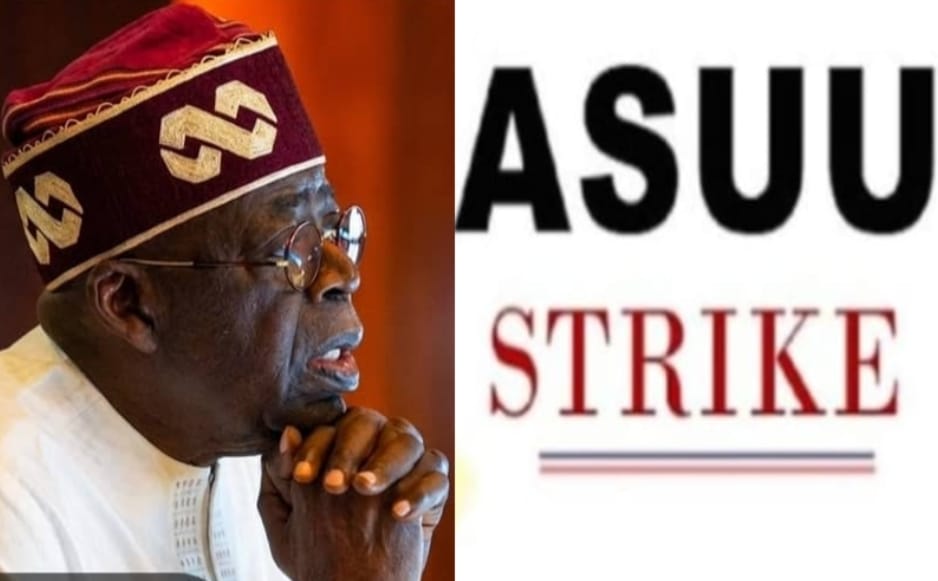
BYE-BYE ASUU STRIKE: HOW PRESIDENT TINUBU IS REBUILDING NIGERIA’S PUBLIC UNIVERSITIES THROUGH PRAGMATIC LEADERSHIP
By Sylvester Udemezue
(1). INTRODUCTION
For over two decades, one of the greatest threats to Nigeria’s public university system was the recurring cycle of strikes by the Academic Staff Union of Universities (ASUU). Successive administrations struggled to break the impasse, leaving millions of students trapped in prolonged academic uncertainty, while lecturers became increasingly frustrated by unmet agreements, poor remuneration, inadequate research support, and deteriorating university infrastructure.
Today, Nigeria appears to be witnessing a remarkable departure from that unfortunate history. While no responsible commentator can claim that industrial disputes have become impossible, there is broad acknowledgment that the administration of President Bola Ahmed Tinubu, GCFR, has made perhaps the most significant progress in many years toward restoring lasting industrial peace within the nation’s public universities through dialogue, negotiation, and concrete welfare reforms.
(2). FROM CONFRONTATION TO CONSTRUCTIVE ENGAGEMENT
Unlike the adversarial relationship that frequently characterised previous engagements between government and university unions, the Tinubu administration adopted sustained negotiation rather than prolonged confrontation. Instead of allowing disagreements to degenerate into another nationwide shutdown of universities, both parties remained at the negotiating table until a comprehensive agreement was reached in December 2025. That agreement replaced the long-disputed 2009 FG-ASUU Agreement, bringing to a close a negotiation process that had lasted approximately sixteen years. This marked a major turning point in Nigeria’s higher education sector.
(3). LANDMARK WELFARE REFORMS FOR UNIVERSITY LECTURERS
Perhaps the most significant achievement of the agreement lies in the unprecedented improvements to lecturers’ welfare. Among the major reforms publicly announced include:
- A 40% increase in the Consolidated Academic and Research Allowance, significantly improving lecturers’ welfare packages.
- Introduction of new Professorial Cadre Allowances for Professors and Readers, recognising academic excellence, scholarship, mentorship, and leadership within Nigerian universities.
- Enhancement of Earned Academic Allowances and related welfare benefits.
- Payment of outstanding Academic Tools Allowance (CATA) arrears owed to lecturers, providing long-awaited financial relief. These measures represent one of the most substantial improvements in lecturers’ welfare in recent years.
(4). RENEWED RECOGNITION OF SCHOLARSHIP AND RESEARCH
One of the enduring concerns of Nigerian academics has been the lack of sufficient institutional support for research, publication, scholarly writing, and academic productivity. The Tinubu administration’s welfare reforms acknowledge that university lecturers are not merely classroom instructors but researchers, innovators, mentors, and knowledge producers whose scholarly contributions drive national development. The improved academic and research allowances are intended to strengthen research productivity, encourage scholarly writing, improve conference participation, and support the broader academic mission of Nigerian universities.
(5). RESTORING STABILITY TO THE ACADEMIC CALENDAR
Perhaps the greatest beneficiaries of the new atmosphere of industrial harmony are Nigerian students. For years, university education in Nigeria was synonymous with uncertainty. Academic calendars became unreliable. Graduation dates became unpredictable. Professional careers were delayed. Families suffered emotional and financial hardship. By substantially reducing the frequency of nationwide industrial disruptions through dialogue and negotiated reforms, the Tinubu administration has restored greater confidence in Nigeria’s public universities and provided students with a more stable learning environment.
(6). A NEW PHILOSOPHY OF LABOUR RELATIONS
President Tinubu’s approach reflects a broader philosophy of governance: resolving difficult national challenges through engagement, compromise, and practical solutions rather than prolonged confrontation. His administration has demonstrated a willingness to listen, negotiate, review inherited disputes, and implement mutually agreed reforms. This approach has helped rebuild confidence between government and university stakeholders.
(7). THE WIDER BENEFITS TO NATIONAL DEVELOPMENT
A stable university system produces benefits that extend well beyond the campuses. Industrial peace encourages uninterrupted teaching and learning; improved research output; better university planning; enhanced international collaboration; stronger investor confidence in Nigeria’s educational institutions; timely graduation of students; and increased national productivity. Education remains one of the strongest foundations of sustainable national development. Every uninterrupted academic session represents an investment in Nigeria’s future.
(8). THE WORK MUST CONTINUE
The progress recorded should not lead to complacency. Nigeria’s universities still require greater investment in infrastructure, laboratories, digital technology, research funding, innovation, postgraduate education, and institutional autonomy. Equally important is the faithful implementation of every aspect of the agreements reached between the Federal Government and ASUU. Sustainable industrial harmony depends not merely on signing agreements but on honouring them consistently. Recent developments also show that implementation by some state governments remains uneven, underscoring that further work is required.
(9). CONCLUSION
History will likely remember President Bola Ahmed Tinubu’s administration as one that fundamentally changed the conversation surrounding ASUU and industrial relations in Nigeria’s public universities. Through patient negotiation, pragmatic leadership, improved lecturers’ welfare, enhanced research-related allowances, settlement of outstanding entitlements, and the conclusion of a landmark agreement with ASUU, the administration has laid a stronger foundation for stability in higher education than Nigeria has witnessed in many years. The task ahead is to consolidate these gains. If successive governments continue on this path of dialogue, faithful implementation, and sustained investment in higher education, Nigeria may finally consign the era of debilitating ASUU strikes to history. That would be a lasting legacy (not only for President Bola Ahmed Tinubu) but for Nigerian education, Nigerian academics, and millions of present and future students whose dreams depend on stable, world-class public universities.
Respectfully,
Sylvester Udemezue (udems)
Proctor,
The Reality Ministry of Truth, Law and Justice (TRM)
08021365545.
udemsonline@gmail.com
(24 July 2026)